Books / AI Economy
AI is rewriting the entire economy. Will Vietnam hold the pen, or let others write for it?
From garment workshops to rice fields, from electronics lines to bank counters, AI is changing how the economy creates value and how each person earns a living. For Vietnam, this is the biggest challenge to its growth model of the past thirty years, and a rare chance to close the gap with the world within a generation. AI Economy explains how that restructuring is unfolding, whom it affects, and what Vietnam must do before 2035.
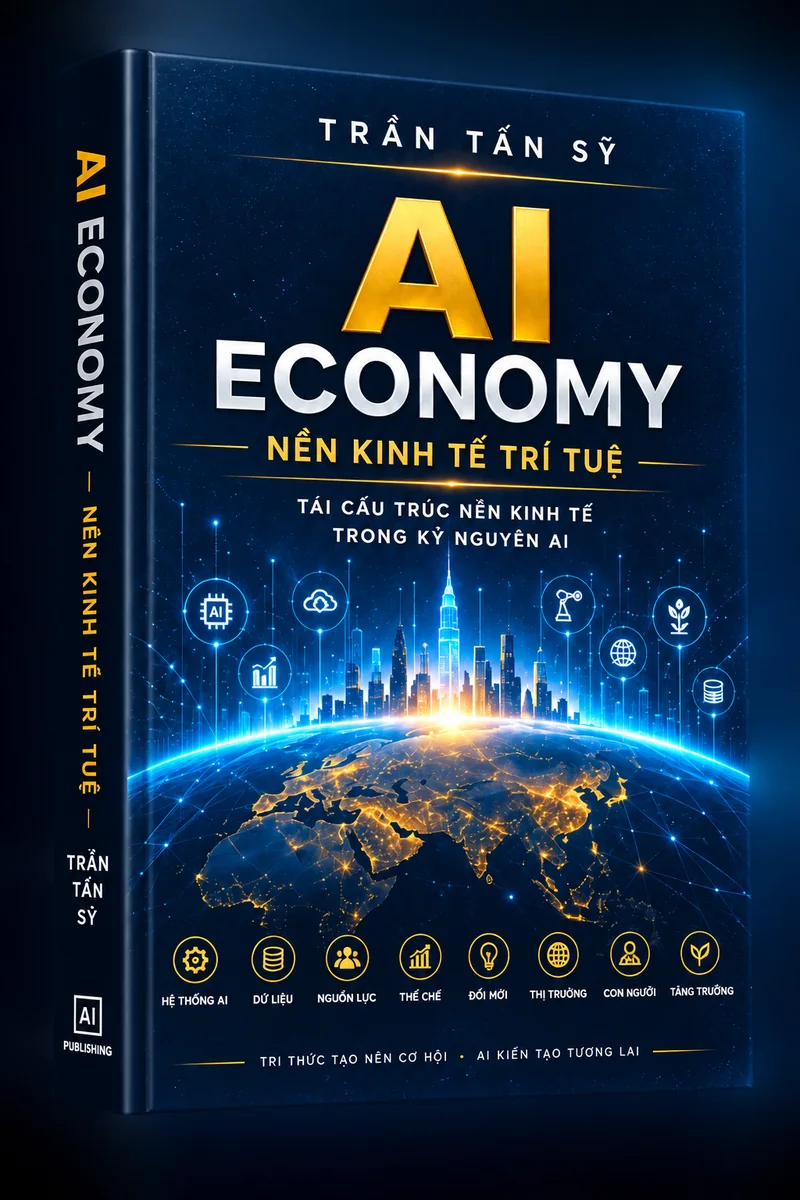
AI Economy: Restructuring the economy in the AI era. By Trần Tấn Sỹ. Ho Chi Minh City Economic Publishing House.
AI Economy: Restructuring the economy in the AI era is a book by Trần Tấn Sỹ on how AI changes the structure of the economy, from capital flows and infrastructure to each industry and each worker. It analyzes AI's impact on growth and jobs in Vietnam, the competitive map of 11 economies, the window of opportunity to 2035, and what the nation, provinces and businesses must do. The appendix includes two self-assessment indices: ARI for provinces and ARI-IP™ for industrial parks.
No longer a matter for the future. It is happening, faster than many think.
AI has already entered Vietnam's economy
- USD 120–130 billionProjected contribution of the AI economy to Vietnam's GDP in 2040. About USD 60–75 billion from cost savings through higher productivity, about USD 45–55 billion from revenue growth
- 80%Vietnamese businesses used AI at work in the past year, above the 69% Asia-Pacific average. 88% of office workers use generative AI regularly, versus 75% globally
- Nearly 4 millionDirect workers in textiles, garments and footwear, two export industries worth about USD 46 billion and USD 29 billion in 2025, and also the two industries under the greatest automation pressure
- 59%Of the global workforce will need retraining by 2030; about 40% of core skills will change
Sources: NIC, JICA, BCG (AI economy's contribution to Vietnam's GDP); Microsoft and Ipsos; Ministry of Industry and Trade, Vietnam Textile and Apparel Association (VITAS); World Economic Forum, Future of Jobs Report. Compiled in AI Economy, Chapters 7, 9 and 10.
AI spares no industry. Each one is being rewritten in its own way.
Earlier technological revolutions replaced production tools. AI simultaneously changes how companies design products, organize production, manage supply chains, serve customers and make decisions. The greatest pressure falls on exactly the industries carrying Vietnam's growth, exports and jobs.
| Industry | What is changing | Opportunity for first movers |
|---|---|---|
| Textiles, garments, footwear | Robots and computer vision inspect defects, optimize cutting layouts and plan production. Orders move to places with high productivity, fast delivery and flexibility | Move from contract manufacturing (CMT, OEM) up to own design (ODM) and own brands (OBM); become a smart manufacturing partner |
| Electronics and assembly | Factories run on data and AI instead of lines relying on large numbers of workers | Capture higher-value stages in the electronics and semiconductor chain |
| Agriculture | AI enters the fields: precision farming, forecasting, traceability | Shift from selling volume to selling value |
| Banking, finance | AI becomes each customer's personal financial expert | Personalized services at the scale of millions of people |
| Industrial real estate | Investors ask about power, water and digital infrastructure before asking about land prices | New-generation industrial parks attract AI Factory and data center capital (ARI-IP™) |
Source: AI Economy, Chapter 9 “150,000 workers disappear, output stays the same”.
A double-digit growth target cannot be reached with the old model.
The Resolution of the 14th Party Congress sets a target of average GDP growth of 10% per year or more for 2026–2030. For thirty years, Vietnam has grown mainly by adding capital, labor and land for industrial parks. All three sources are hitting their ceiling: as robots become cheaper, cheap labor is no longer the decisive advantage, land cannot expand forever, and technology capital has changed its criteria for choosing where to invest.
The missing growth can only come from productivity. In this decade, the biggest productivity lever is AI: according to NIC, JICA and BCG, more than half of AI's contribution to Vietnam's GDP comes from cost savings through higher productivity. The book says it plainly: the biggest risk is not that AI develops too fast, but that the economy adapts more slowly than technology changes.
The rules of capital have also changed. In 2025, Vietnam attracted USD 38.42 billion in registered FDI from thousands of projects. In the same year, a US technology group announced more than USD 50 billion for a single data center. Provinces with power, computing infrastructure, engineers and fast procedures will capture capital flows of that size.
For the first time, the gap between nations is not measured in natural resources or muscle power.
Thirty years ago, Vietnam seized one window of opportunity when it welcomed the manufacturing FDI wave from the early 1990s. A second window is opening, and this time the rules are fairer: a nation's destiny is increasingly decided by its ability to master AI and the speed at which it turns knowledge into productivity. The AI tools Vietnamese businesses use today are the same tools used by businesses in leading economies, and Vietnam's AI adoption rate has already surpassed the regional average.
McKinsey estimates that AI software and services alone could reach USD 1.5 to 4.6 trillion in revenue by 2040. This is a market that a late-developing economy like Vietnam can join from the start, instead of playing catch-up.
What Vietnam still lacks is also clear: rank 64/170 in frontier technology readiness, down 11 places from 2022; rank 120/170 in skills; more than 85% of heavy AI computing workloads of domestic businesses and startups still run on foreign cloud infrastructure. The window remains open until around 2035, exactly the stretch on Vietnam's path to its 2045 high-income goal. Miss it this time, and the price is decades of chasing an ever-widening gap.
Questions the book answers
- In what ways is AI restructuring the economy, and where does the new value flow?
- Which industries in Vietnam come under pressure first, which groups of workers lose out, and which rise?
- Why is growth based on cheap labor and FDI no longer enough for the new targets?
- Where is global AI capital flowing, and with what advantages are the US, China, the EU, Taiwan, the Netherlands, South Korea, Japan, the UAE, Israel, India and Singapore claiming their place?
- What must the nation, each province and each business do before 2035?
The book's three parts
- Part I. The new rules. The explosion of intellectual productivity, inside the intelligence factory, six destinations of AI capital, three levels of AI sovereignty, the nine layers of the intelligence economy, and the power map of the major powers, the small countries that hold supply-chain chokepoints, and the countries accelerating with their own advantages.
- Part II. Vietnam enters the game. The window of opportunity to 2035, four waves of FDI, seven advantages and seven structural gaps, eight readiness pillars, the five industries hit first, and the polarization of the workforce.
- Part III. Action. Five pillars for building national competitiveness, the role of business, and the choices facing each actor.
Key concepts
| Concept | Definition |
|---|---|
| Intelligence factory (AI Factory) | Large-scale computing infrastructure that produces “intelligence” like an industrial plant, with a training line and an inference line |
| The nine layers of the intelligence economy | The author's framework describing value created across nine layers, from energy and physical infrastructure to macroeconomic impact and national standing |
| Three levels of AI sovereignty | Distinguishes between hosting data centers on national territory and truly mastering the technology |
| AI Readiness Framework™ | Eight readiness pillars of a nation or province; the basis of the ARI index |
| The 2035 window of opportunity | The period in which Vietnam can still win a place in the AI value chain before those places are all taken |
Companion tools
Who the book is for
- Provincial and city leaders, and departments in charge of investment, industry, science and technology.
- Economists, policymakers and researchers who need a framework for reading AI's impact on growth and jobs.
- Developers and management boards of industrial parks, high-tech parks and economic zones.
- Investors, banks and funds interested in infrastructure and the technology supply chain.
- Business leaders who need to understand the big picture before making AI investment decisions.
- Anyone who wants to know how AI will touch their industry and their job.
Publication details
| Item | Details |
|---|---|
| Title | AI Economy · Nền Kinh tế Trí tuệ: Restructuring the economy in the AI era |
| Author | Trần Tấn Sỹ |
| Publisher | Ho Chi Minh City Economic Publishing House |
| ISBN | 978-604-346-627-0 |
| Publication registration number | 3831-2026/CXBIPH/02-46/KTTPHCM |
| Pages | 330 |
| Format | 16 × 24 cm |
FAQ
What is AI Economy about?
How AI is restructuring the economy: its impact on each industry, on growth and jobs, AI capital flows, competition between nations, and what Vietnam must do before 2035.
How will AI affect Vietnam's economic growth?
According to NIC, JICA and BCG, the AI economy could contribute USD 120–130 billion to Vietnam's GDP in 2040, more than half from productivity gains. As cheap labor and traditional FDI are no longer enough, AI-driven productivity is the largest source of additional growth.
Will AI take away workers' jobs?
AI changes the kinds of jobs more than the total number of jobs. The World Economic Forum forecasts that by 2030 about 92 million jobs will disappear and about 170 million new jobs will appear. People who know how to use AI to raise productivity will have the edge; Chapter 10 identifies which groups need to prepare urgently.
Are AI Economy and Nền Kinh tế Trí tuệ two different books?
No. AI Economy is the English title printed on the cover of Nền Kinh tế Trí tuệ.
Why is the window of opportunity said to close in 2035?
Because corporations are choosing where to place AI infrastructure for the next two decades right now. Provinces that get ready late will have to compete for what is left.
Is the book for businesses?
Yes. Businesses need to understand how their industry is being rewritten before choosing a direction. The detailed implementation is in AI First Business.
Where can I buy the book?
The book is published by the Ho Chi Minh City Economic Publishing House. To order, including bulk orders: info@iepvn.com or call / Zalo +84 833 28 68 13.
Data sources: NIC, JICA, BCG; Microsoft and Ipsos; Ministry of Industry and Trade, VITAS; World Economic Forum; McKinsey Global Institute; Foreign Investment Agency (FDI 2025); UNCTAD, Technology and Innovation Report 2025; Resolution of the 14th National Party Congress (growth target). The full source list is in Appendix C of the book.
AI Economy answers at the national level.
To bring that answer into your business, read on with AI First Business.